
Datasets
Transcriptional profiles of immature neurons in aged human hippocampus track Alzheimer’s pathology and cognitive resilience. Cell Stem Cell, 2026.
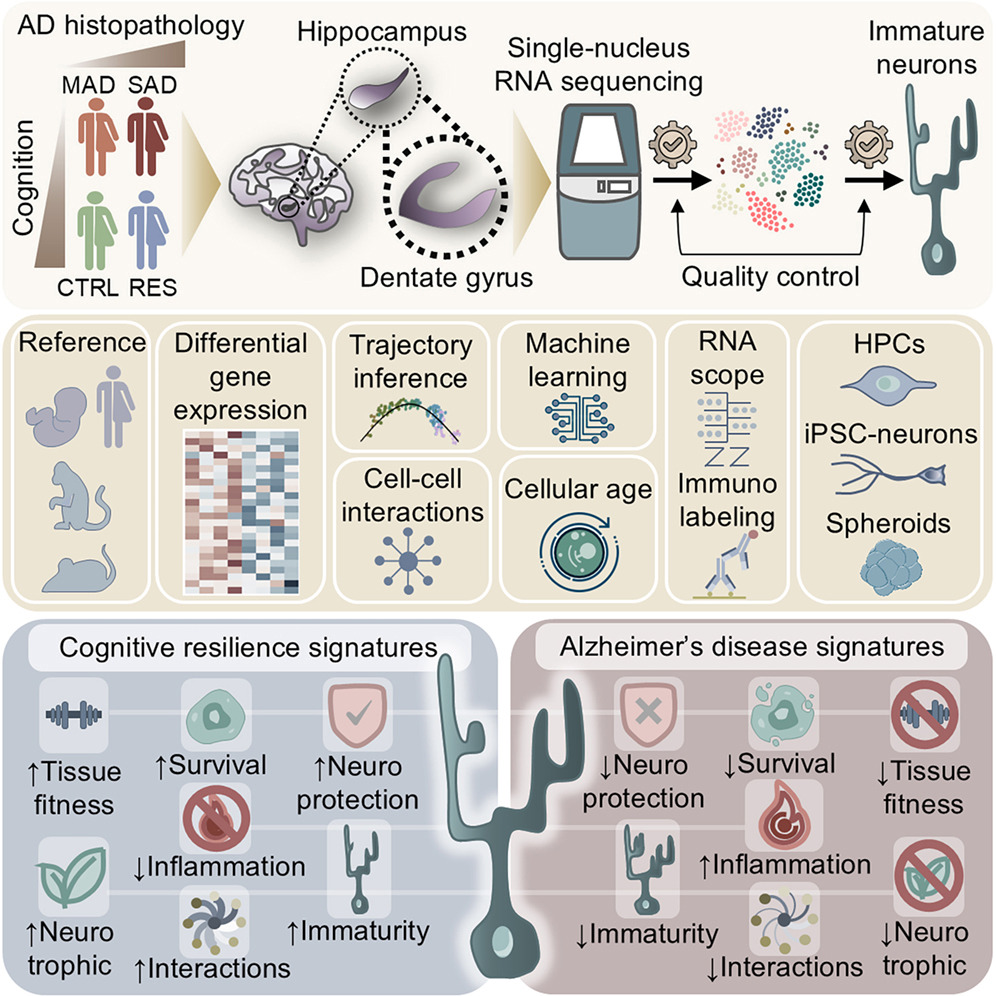
The existence and functional significance of immature neurons in the adult human brain, particularly in the context of neurodegenerative disorders, remain an open question. Although rodent studies have highlighted active roles for adult-born immature neurons in the hippocampus both under healthy conditions and in Alzheimer’s disease (AD), evidence from the human brain is limited and lacks detailed molecular characterization. To address this gap, we performed single-nucleus RNA sequencing in aged healthy, AD, and dementia-resilient human hippocampus samples to probe immature neuronal signatures and gene expression alterations associated with AD pathology and resilience. By applying an integrated experimental and computational pipeline, we identified persistent populations of immature neurons across all donor groups, with transcriptional profiles reflecting ‘juvenile’ cellular functions, which are compromised in AD. Our findings suggest that the presence of these immature neuronal populations per se may actively contribute to maintaining homeostasis within the aged human hippocampus and to cognitive resilience in AD.
Download the processed data and scripts
microRNA-132 attenuates inflammation in induced pluripotent stem cell-derived microglia from Alzheimer’s disease patients. Acta Neuropathol Commun, 2026.
Microglia, the resident immune cells of the brain, are increasingly recognized as key contributors to Alzheimer’s disease (AD) pathology. Multiple studies have identified microRNA-132 (miR-132) as one of the most significantly downregulated microRNAs in AD. Apart from well-established pleiotropic regulatory functions in neurons, previous evidence also suggested a role for miR-132 in regulating (neuro)inflammation. Yet, the precise mechanisms by which miR-132 impacts microglia remain unknown. In this study, we investigated the role of miR-132 in modulating microglial gene expression and function using gain- and loss-of-function approaches in human-induced pluripotent stem cell (iPSC)-derived microglia (iMGs) from both healthy controls and sporadic AD (sAD) patients. Our findings indicate that while miR-132 may not be indispensable for some baseline microglial functions, increasing its expression in sAD iMGs can reverse disease-associated gene expression changes and attenuate inflammatory responses. To further explore its therapeutic potential, we overexpressed miR-132 in hippocampal neurons of an AD mouse model, employing a clinically relevant adeno-associated viral (AAV) delivery method. miR-132 overexpression was well-tolerated and induced non-cell autonomous effects in microglia. This study sheds light into the regulatory role of miR-132 in microglia under both physiological and AD conditions, and emphasizes the importance of optimizing safe dosage parameters for future clinical applications.